
99%+ Purity
Guaranteed per batch
Licensed Peptides sells to approved research accounts only.
Log in Apply for an accountResearch Use Only. Products are intended strictly for laboratory research and not for human or animal consumption. You must be 21 or older.
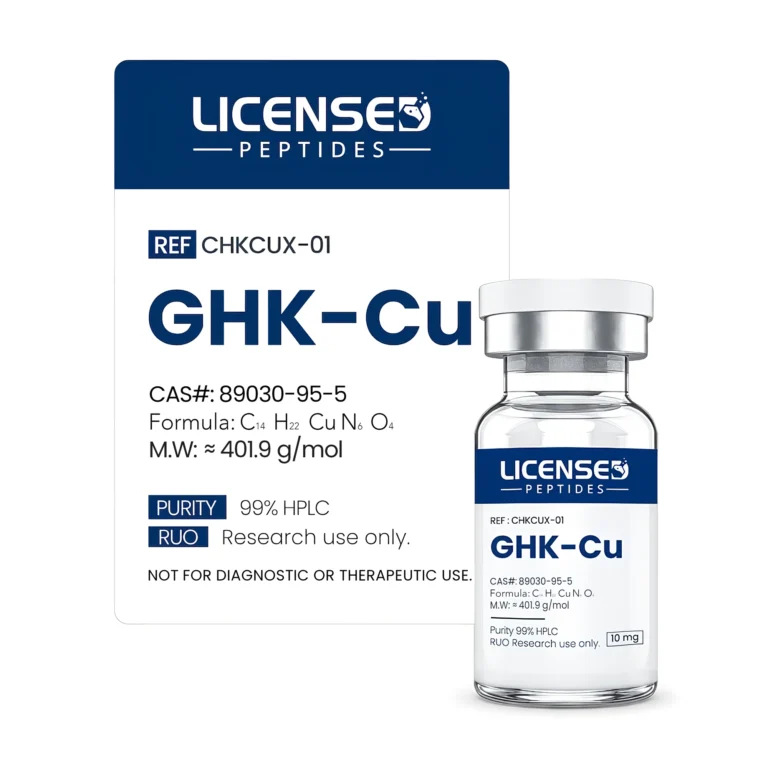
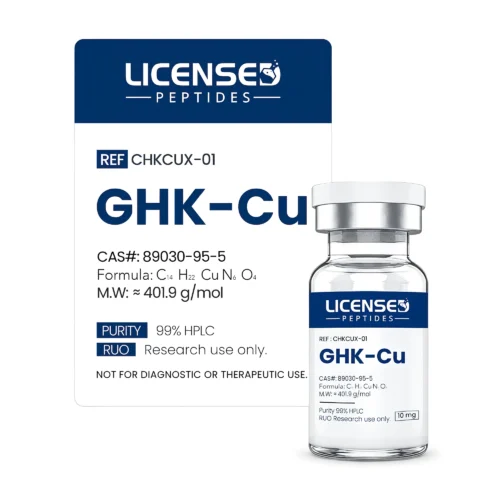
 99%+ HPLC Purity —
Independently verified by accredited US laboratory
Endotoxin-Screened —
LAL tested, LPS-free, endotoxin report available
GMP-Certified Manufacturing —
USA facility, ISO 9001:2015
Lyophilized for Stability —
Shipped cold-packed, intact for reconstitution
Structure, physicochemical data, analytical verification and safety documentation for GHK-Cu. Supplied for in-vitro laboratory research only.
Two-dimensional structures generated with RDKit and drawn in the site palette. Tap a drawing to enlarge it. Below each drawing, the residue chain in one-letter code with the three-letter name and position; colours mark the side-chain class, a dashed outline marks a D-residue or a non-proteinogenic residue (lower-case letters are D-residues).
 Tap to enlarge
2D depiction, C14H23CuN6O4, generated from the PubChem connection table, CID 71587328.
H-Gly-His-Lys-OH
Formula, masses and identifiers from PubChem where a record exists, checked against an independent RDKit calculation and, for peptides, against the residue sequence. Theoretical pI, net charge at pH 7.4, GRAVY and the 280 nm extinction coefficient are calculated with Biopython ProtParam on the residue chain (Bjellqvist pK set; Kyte-Doolittle; Gill and von Hippel) and are marked "calculated"; they are not given where the chain contains non-proteinogenic residues.
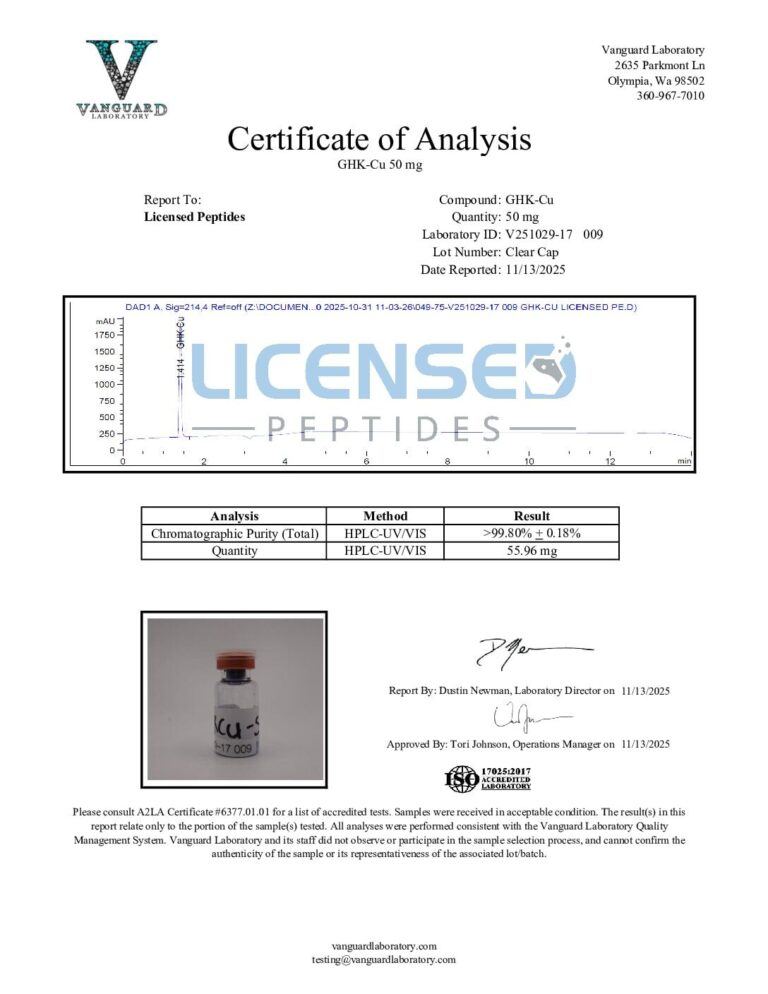
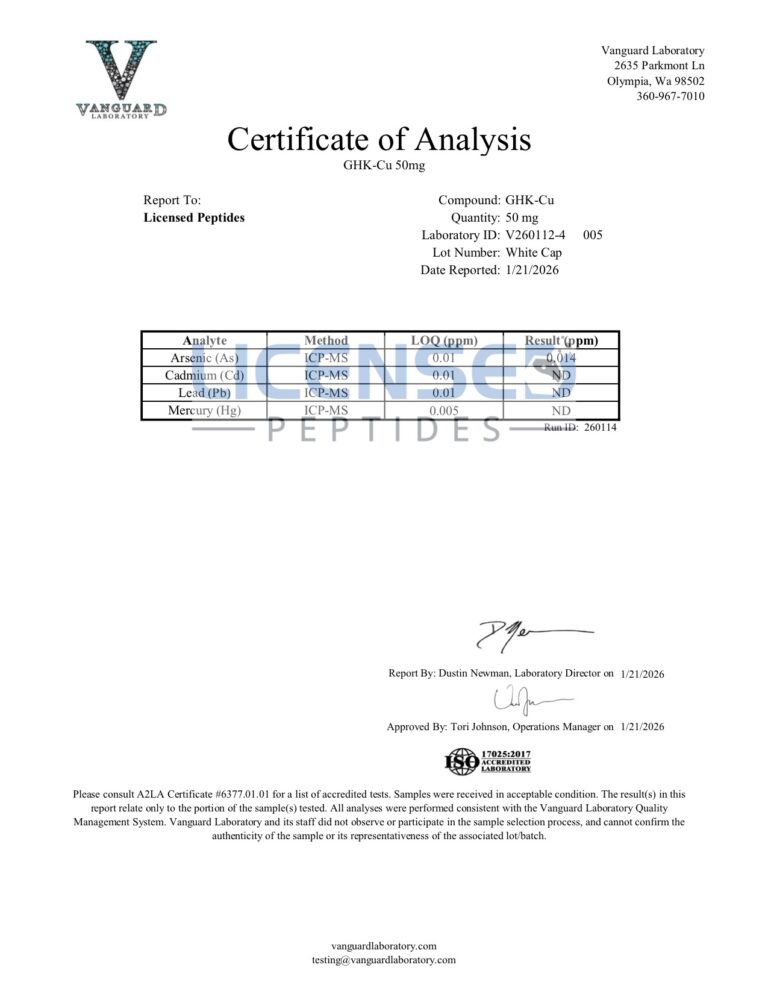
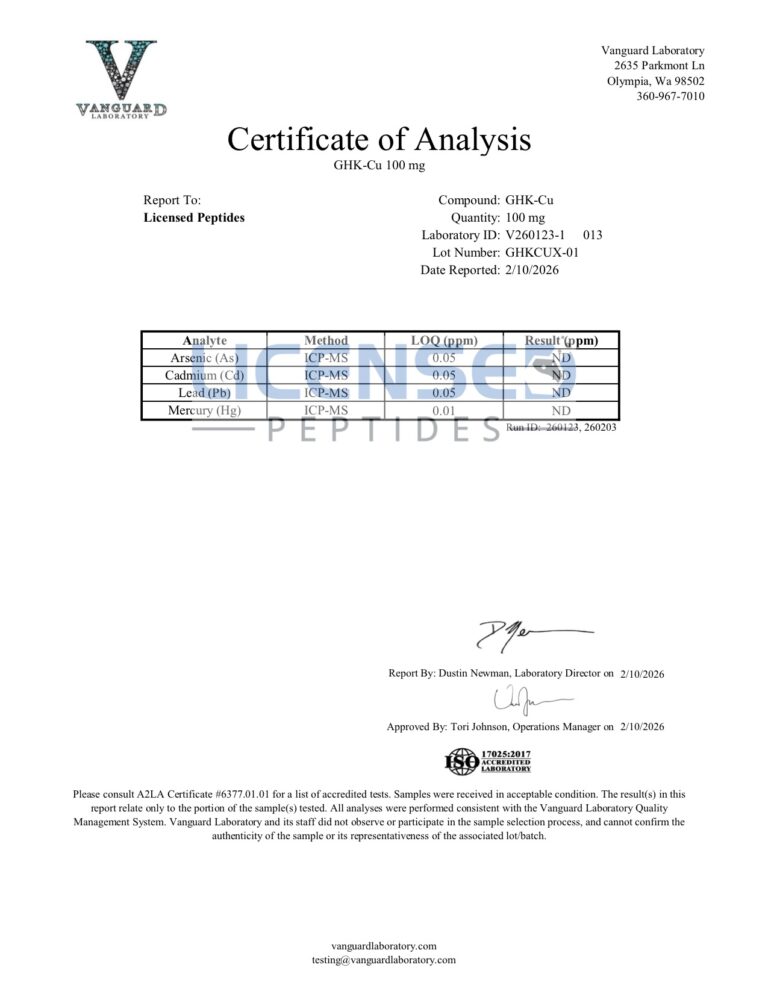
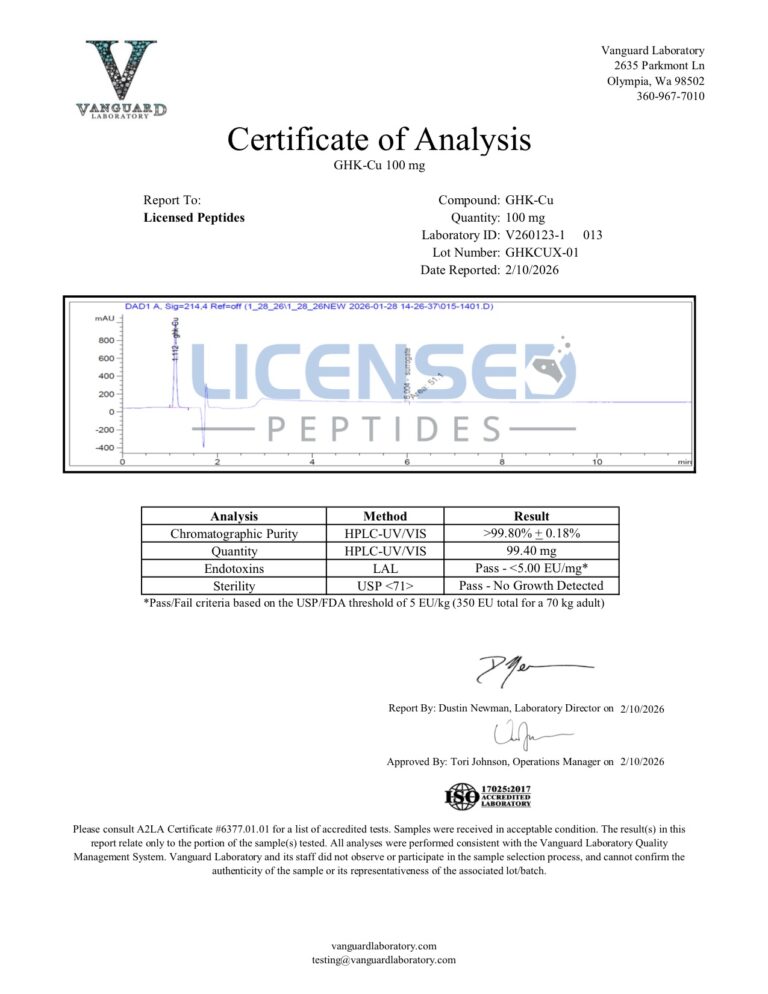
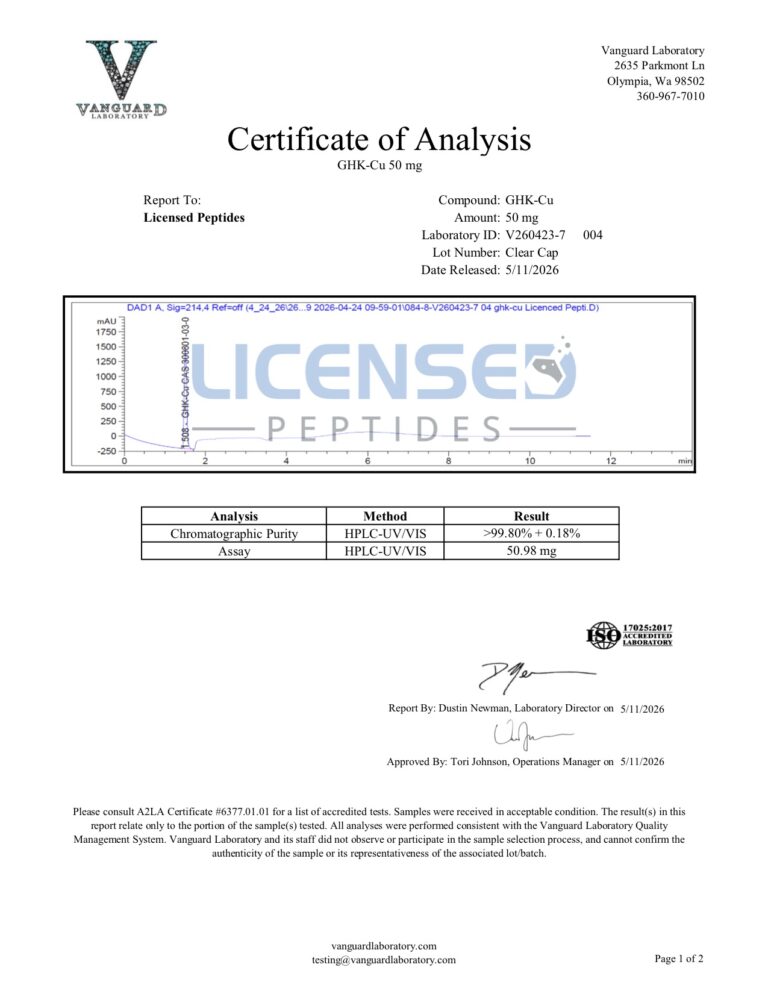
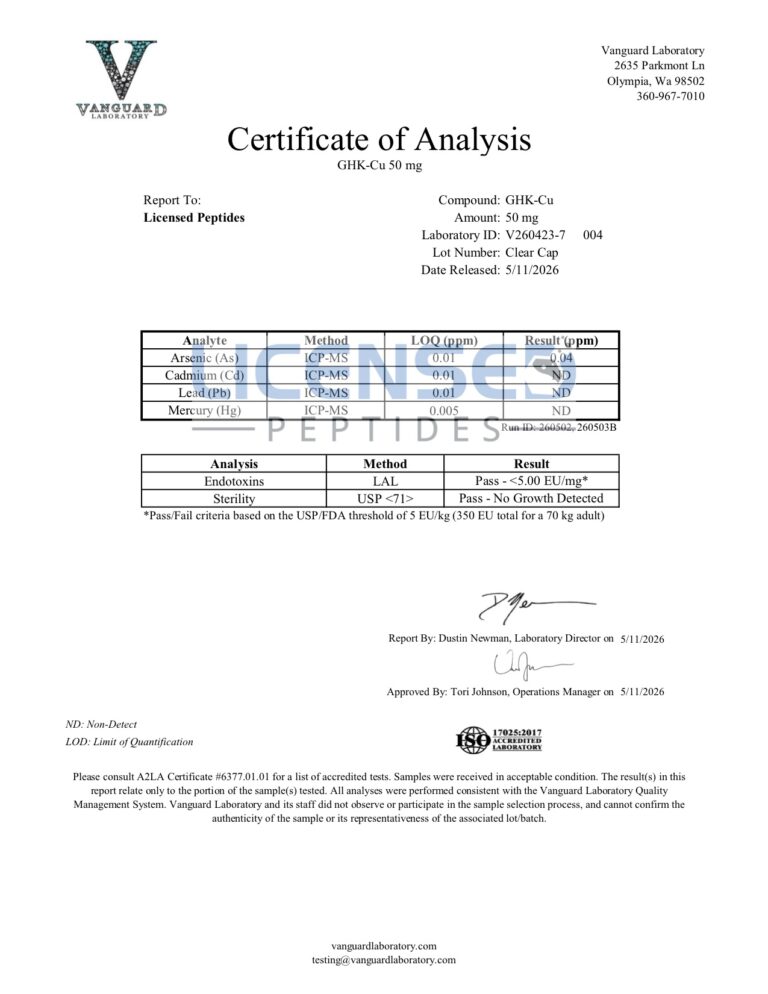
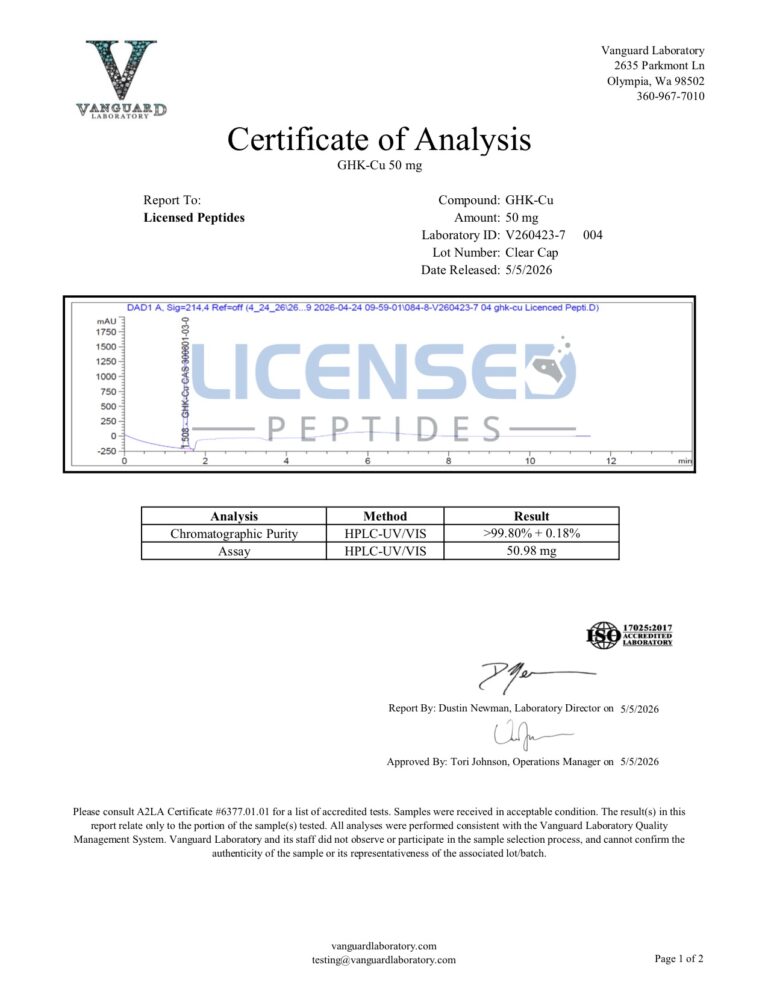
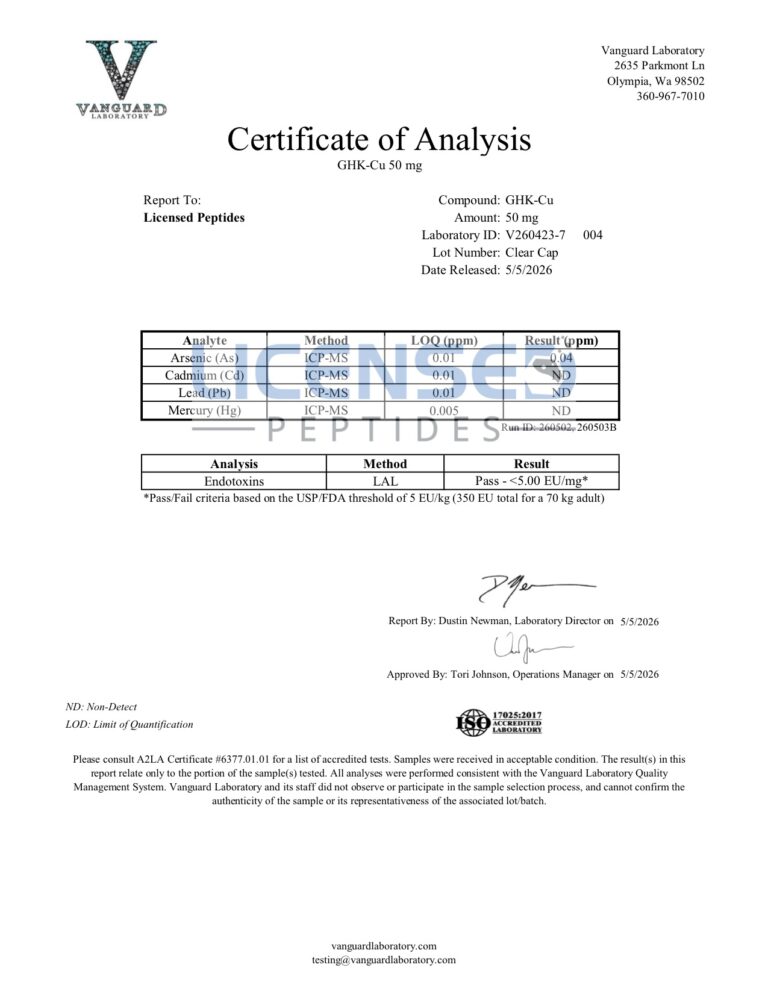
Tests reported for the current lot on file by Vanguard Laboratory, ISO/IEC 17025:2017, A2LA #6377.01.01 (released 5/11/2026): reversed-phase HPLC with UV detection (chromatographic purity by peak area, content against the label claim); LAL bacterial endotoxin; ICP-MS heavy metals. Only the tests listed below are part of this lot's report.
 Tap to enlarge
HPLC-UV chromatogram, full trace, from page 1 of the lot Certificate of Analysis (diode-array detector, 214 nm).
| Test | Method | Result |
|---|---|---|
| Chromatographic purity | HPLC-UV/VIS | >99.80% |
| Content (label claim 50 mg) | HPLC-UV/VIS | 50.98 mg |
| Bacterial endotoxin | LAL | <5.00 EU/mg (LAL, USP <85>) |
| Heavy metals | ICP-MS | Arsenic (As) 0.04 ppm, Cadmium (Cd) ND, Lead (Pb) ND, Mercury (Hg) ND |
Summaries of published papers, written for qualified researchers. They describe the published work, not this product.
GHS-format safety data sheet, 16 sections. Revision 2026-11-04, version 1.0. "No data available" is stated wherever no measured data exist for the substance.
Guaranteed per batch

Independent lab verified

Vanguard Laboratory · ISO/IEC 17025

USA-manufactured

Free FedEx on $200+
Not all peptide vendors hold themselves to the same verification standards.
| Verification Standard | Licensed Peptides | Generic Vendors |
|---|---|---|
| HPLC Purity Analysis |  99%+ Every Batch |
 Often Not Disclosed |
| Endotoxin Screening (LAL) | Every Product |
Industry Exception |
| GMP-Certified USA Manufacture | ISO 9001:2015 |
Often Overseas |
| COA Published & Downloadable | Every Lot |
Inconsistent |
| Same-Day USA Fulfillment | Before 4PM PST |
3-10 Day Lead Time |
GHK-Cu is a copper-binding tripeptide made from glycine, histidine, and lysine. This particular peptide binds with a copper ion, which creates a peptide-metal complex that researchers can examine in biochemical and cell-based studies.
Researchers study GHK-Cu in laboratory models for a number of reasons:
• Copper coordination (how the GHK peptide binds and transports copper ions)
• Cell signaling (how it delivers messages to direct cellular action, such as repairing damaged structures)
• Fibroblast activity (how GHK-Cu affects the primary builder cells in connective tissue and skin)
• Extracellular-matrix processes (how GHK-Cu helps manage and rebuild the structure that surrounds cells)
• Gene expression (the ability for GHK-Cu to turn specific genes “on” and “off”)
Yes, GHK-Cu occurs naturally. It was first isolated in 1973 from human blood plasma by biochemist Dr. Loren Pickart. As well as blood plasma, researchers have identified GHK and its copper-bound complex in biological systems. Naturally occurring levels vary according to the biological material being measured, in addition to the analytical method.
Copper is important in GHK-Cu research because it’s the central metal component of the GHK-Cu complex. Researchers are interested in examining how GHK binds and transports copper and how this interaction affects biochemical signaling under controlled experimental conditions.
Some cell-culture studies have examined GHK-Cu in relation to fibroblast activity, collagen production, and extracellular-matrix signaling, all of which link to collagen-related pathways.
LPS stands for “lipopolysaccharide”, a component of certain bacterial cell walls. LPS is an endotoxin; even tiny trace amounts can bring unwanted variables into sensitive laboratory assays, which causes skewed experiments and ruined data. Because of this, laboratories use endotoxin testing to assess the presence of LPS. At Licensed Peptides, we ensure all GHK-Cu undergo endotoxin screening to ensure the peptide’s purity and quality.
Each report identifies:
• Product name
• Product strength
• Laboratory ID
• Lot or sample identifier
• Report date
• Testing laboratory
• Analytical method
• Chromatographic purity
• Measured quantity
• Applicable heavy-metal results
Here at Licensed Peptides, we supply GHK-Cu as a lyophilized research material. When preparing for laboratory research, ensure you select solvents, buffers, and working concentrations according to:
• The selected experimental model
• Validated laboratory procedures
• The analytical method you require
• The intended assay conditions
• The accompanying product documentation
If you would like more general laboratory information, you can refer to our Peptide Solubility Guide.
Not all peptide vendors hold themselves to the same verification standards.
99.4% HPLC Verified · Endotoxin-Screened · GMP-Certified ·
Free FedEx 2-Day on $200+
You cannot copy content of this page
Third-party tested peptides, shipped cold from the U.S. in 1–2 days.
Shop all peptides